In this article we cover:
- Solar component details
- Background to the project and choice of system
- How the system works in practice
- AI integration
- Automatic backup power
- Performance
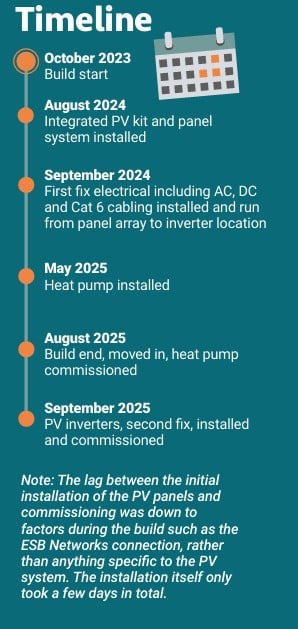
- Timeline and specification
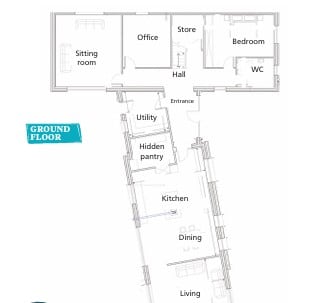
- Floor plans and supplier list
- Examples of consumption data
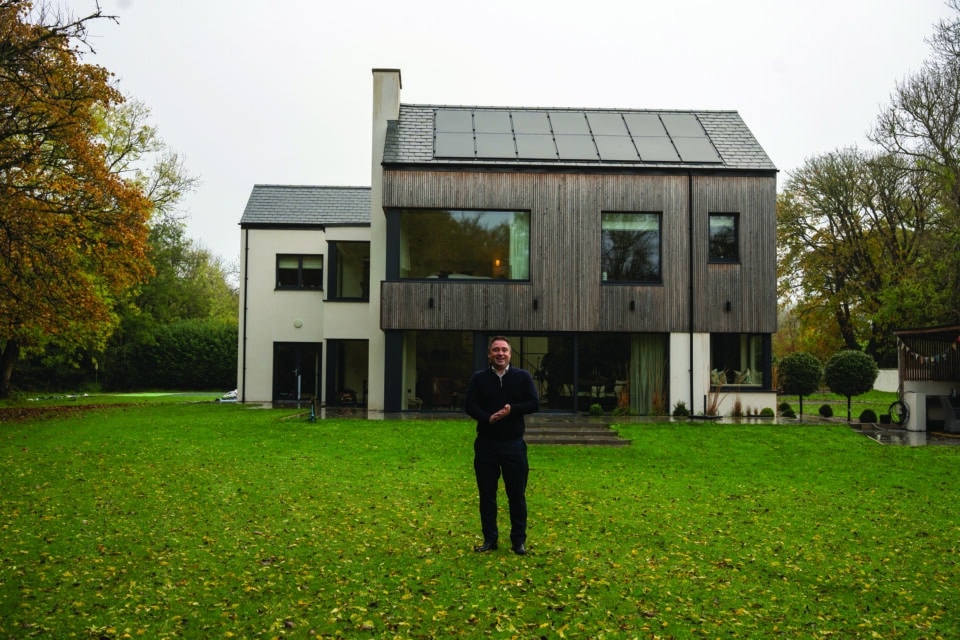
John and Anne Graham of Co Meath set out to build their home with a very clear idea in mind. “We were lucky to be building on a greenfield site in a rural area, in a gorgeous location. However, considering how remote we are, we knew we’d need to do some futureproofing. And that’s why energy independence was high on our list of priorities,” says John.
“Photovoltaic (PV) panels were a no-brainer, but we didn’t want them to detract from the look of the house. So that was part of the design brief we gave our architectural designer, from the very start. We wanted to make a feature out of them.” The couple installed solar panels integrated with a heat pump, a top of the range battery and a high tech monitoring system. The result is a smart, integrated energy ecosystem that adapts automatically to the seasons.
“From the outset we knew we wanted to create a fully electric home that could generate, store and manage its own clean energy,” adds John. “All with a view to reducing our reliance on the grid and keep running costs under control.” “We wanted a system that would be able to run the heat pump as cheaply and efficiently as possible, maximising its use of PV. And we wanted robust storage capacity to weather the storms and enhance our energy independence.”

Overview
Plot size: 1 acre
House size: 282sqm
Bedrooms: 4
Construction: cavity wall (blockwork)
Heating and hot water: air to water heat pump
Ventilation: Centralised mechanical with heat recovery
Preliminary BER: A2
System details
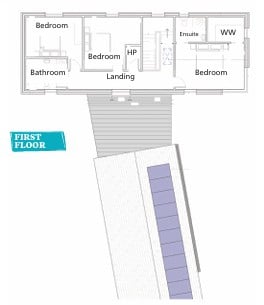
The PV system was carefully sized to meet household demand while comfortably supporting the heat pump. Installed across south-south west and east-south-east roof slopes, the solar panels generate energy from morning through to evening, maximising yield across the day.
“The company that installed our system looked at the size of the house, heating requirements, roof space and other prospective electrical loads,” explains John. “They designed the system around these parameters and installed it while we were at roofing stage. They came back to complete the first fix and second fix electrical work as our build progressed.”
“They handled all the ESB Networks paperwork, liaising with them on grid connection. It was all pretty seamless and we didn’t have to think about it too much, which was very welcome as bandwidth can be low in the middle of a build.”
Built using bifacial cell technology, the panels capture reflected light and maintain performance, even in diffuse Irish conditions. Their double-glass construction (2 mm front and back) offers excellent durability and corrosion resistance – vital for coastal or exposed sites.
“The system is backed by a 30-year product and performance warranty, Fire Class A panels and batteries designed and backed by a high-end car brand,” adds John. “When it comes to safety and expected performance, these warranties and standards have given us real peace of mind.”
With the ability to discharge up to 5kW, the battery can easily support high demand loads such as the heat pump or EV charger. Crucially, it can discharge down to 0 per cent, meaning the full 10.2 kWh of energy storage is usable. “We saw some batteries that could only discharge at 2.5 kW or where only 80 per cent of capacity was accessible,” John says. “We wanted to be able to run the whole house, and the car, directly from stored power.”
A key innovation in this system is the DC-to-DC connector, which allows the PV array to charge the battery directly from the DC side, bypassing the inverter. This means higher efficiency, lower conversion losses and, when generation allows, the ability to charge the battery at more than 5kW, further boosting flexibility and responsiveness.


The couple installed solar panels integrated with a heat pump, a top of the range battery and a high-tech monitoring system. The result is a smart, integrated energy ecosystem that adapts automatically to the seasons.
AI integration
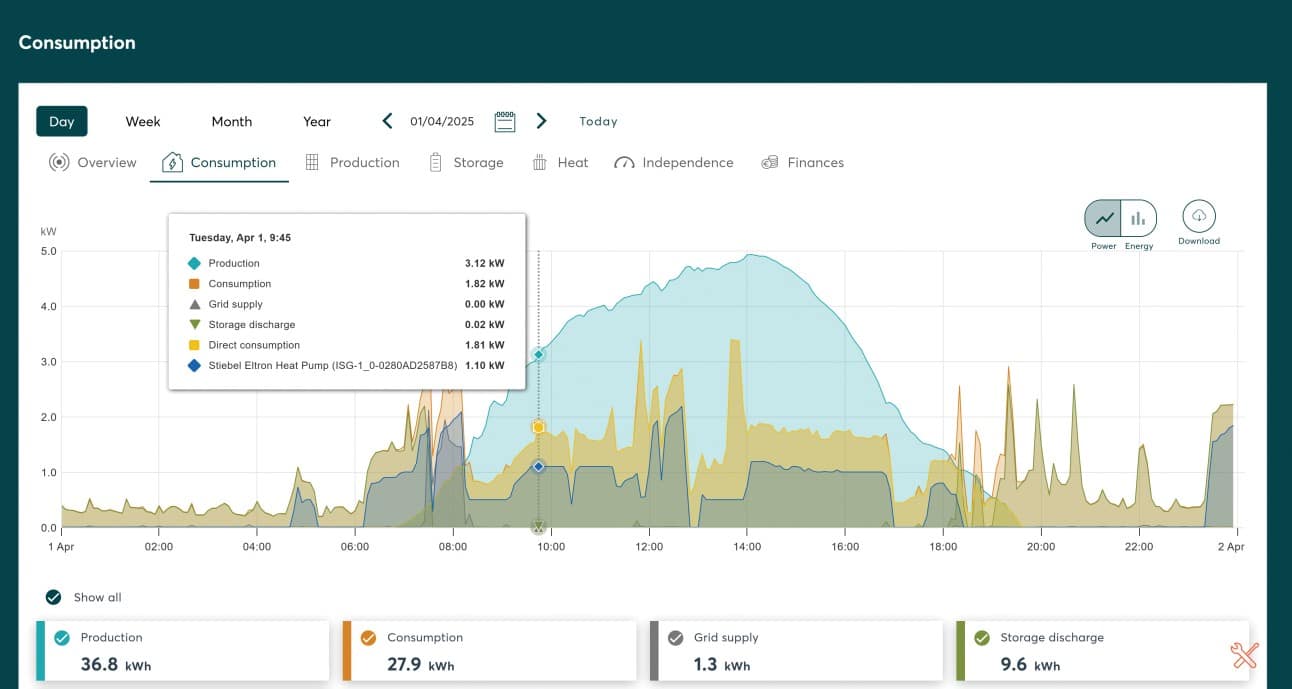
At the heart of the system sits the smart energy management hub that connects and coordinates the PV inverter, battery and heating system. It continuously analyses real-time data on generation, storage, household demand and electricity tariffs, then automatically decides when to generate, store or release power.
This intelligence extends to the heating system. The homeowners’ air-source heat pump communicates directly with the smart energy manager via an Internet Service Gateway (ISG).
Together, they create a fully synchronised energy loop that optimises when the heat pump operates, pre-heating water in the tank when solar generation is high or off-peak tariffs are available.
All this activity is displayed clearly on the energy manager portal, where the homeowners Automatic backup power can view PV generation, battery charge, heat pump operation and total energy flow in real time.
“Basically, the smart energy manager talks to our inverter, battery and heat pump to ‘optimise’ our behaviour. Optimisation involves building smart operating profiles for devices to switch them on when there’s excess solar PV, or an off-peak tariff period.
Using smart shelly plugs or SG ready devices we can optimise a whole host of things, i.e. dishwasher, washing machine etc.” The system can be expanded with a smart power diverter (to use excess electricity to pre-heat the water in the hot water tank), an EV Charger (so the car can charge directly from excess solar power or off-peak tariffs), and more to allow for a fully integrated smart home solution, designed to operate on as much cheap and clean solar power as possible.
Automatic backup power
A key feature of this system is its integrated backup capability. If a power cut occurs, the battery can provide 5kW of power on the spot, which means that high consumers like the heat pump can be run if necessary.
The panels can also be wired so they generate in backup mode, for when there is no grid power. How many days they last will depend on battery size, the amount of panels and how much they generate plus the size of the electrical load.
Turning off high consumers during a blackout and focusing on essentials can significantly increase this period. “So if you are charging your car, you might get a couple of hours,” says John. “However, if you are only running essential circuits, perhaps a few days.”
For rural properties, it’s a reliable home energy safety net that keeps comfort and functionality intact even when the grid is down. “Investing in the best system we could get was a priority for us,” John says. “It made sense in the long run, and we were keen to have a system that would be able to weather storm seasons.”
Performance
“The system went live shortly after we completed the build, and the performance has already exceeded expectations,” says John. “Based on simulation data and experience to date, we expect our electricity bills to be around 60 per cent lower than they would have been without solar.”
The ability to charge the battery overnight on cheaper rates and discharge during the day avoids peak-time tariffs and further enhances savings. “We’re still learning how best to use it,” says John. “But even now, the difference is huge.
The savings are real, and it’s great to know we’re running the house largely on our own power.” One of the system’s greatest strengths is its adaptability. In winter, the battery charges overnight on off-peak electricity, then discharges during the day to power the heat pump and daily loads, maintaining low costs despite reduced daylight.
By summer, the system switches to full solar self consumption, with the smart energy manager prioritising household and hot water loads at times of peak generation. Efficiency also comes from optimising the settings on the system, says John. “I’ve heard of other people saying their heat pump system made their house too warm. I think that must have to do with the system not having been commissioned correctly at the start, or just poor heating controls.
Because I have to say the comfort level of our home couldn’t be any better.” “We can control how warm we want it through the monitoring system; it’s really easy to use. What we have now is an incredibly comfortable space and with the ventilation system, the excellent air quality is palpable. I’d never lived in a house like this before and it’s really something else.”
The panels can also be wired so they generate in backup mode, for when there is no grid power. It depends on the set-up but if you are only running essential circuits, the battery could last for a couple of days.
Spec
Walls: 150mm cavity wall with PIR full-fill insulation, U-value 0.18W/ sqmK
Roof: 150mm mineral wool insulation and 63mm insulated plasterboard (PIR), U-value 0.12 W/sqmK, roof finish black natural slate
Floor: standard build up with 140mm PIR insulation (2x70mm overlapping), U-value 0.13W/sqmK
Windows and doors: triple glazed aluclad windows, overall U-value 0.73W/sqmK; sliding doors triple glazed aluclad, U-value 1.2W/sqmK; front and side doors engineered timber and steel U-value 1.1W/sqmK
Co Meath project suppliers
PV system design and installation Local Power Ltd, Co Meath, localpower.ie, [email protected]
Solar technology SOLARWATT Technologies Ltd (Dresden, Germany), solarwatt.co.uk, info. [email protected]
Heating and hot water technology STIEBEL ELTRON, stiebel-eltron.ie Ventilation Vent-Axia Sentinel Kinetic Highflow MVHR, vent-axia.com
Windows and doors Munster Joinery, munsterjoinery.ie Underfloor heating design Midland Renewables
Main contractor Delra Construction
Architectural design ATC Building Surveying & Engineering Consultancy Ltd
Solar components
9.66kWp solar array consisting of 23 x SOLARWATT Panel vision (glass-glass modules) AM 4.5 (420 Wp each)
5kW SOLARWATT Inverter Vision
10.2 kWh SOLARWATT Battery Vision
SOLARWATT Manager flex, the smart energy management hub
STIEBEL ELTRON WPL HK 230 Premium air-source heat pump communicates directly with the SOLARWATT Manager flex via the STIEBEL ELTRON Internet Service Gateway (ISG) and EM.trend software
HSBC tank, which is a STIEBEL ELTRON integral cylinder system that combines a domestic hot water tank and a buffer tank into a single space-saving unit