In this article we cover:
- What is a Net Zero home?
- The road to Net Zero: timeline in Ireland to 2030
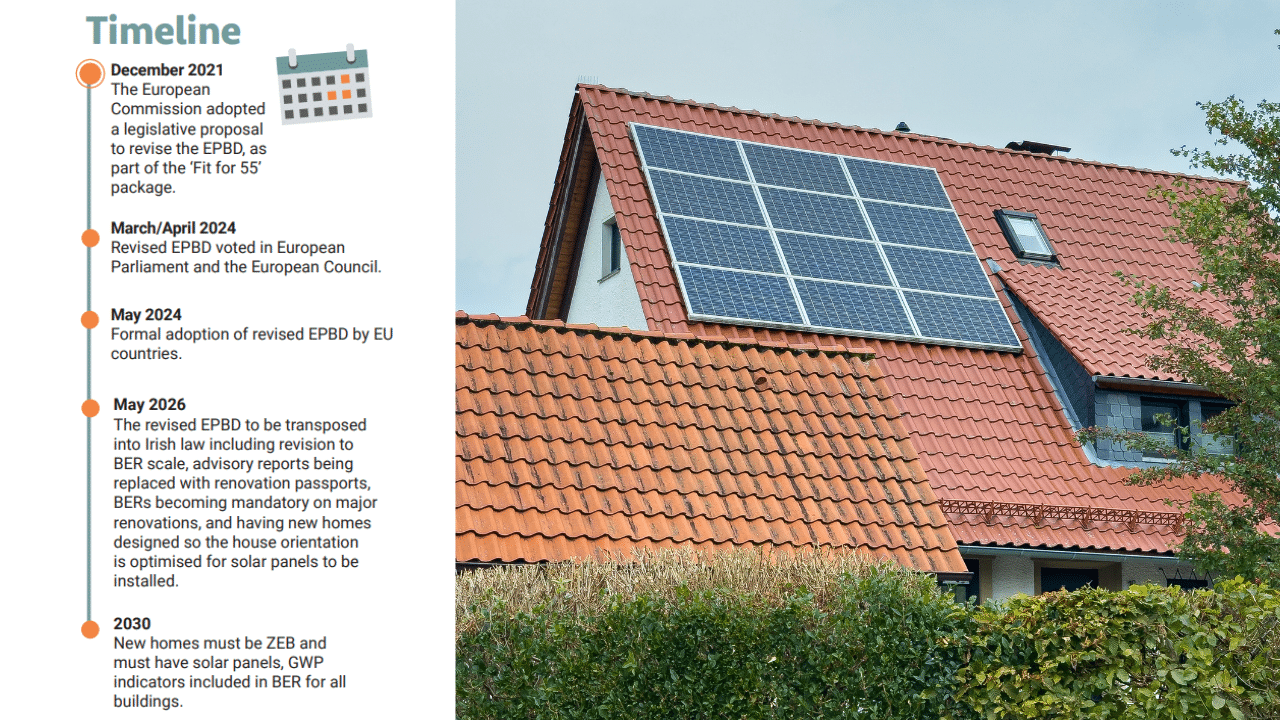
- May 2026 deadline: what you need to know
- What are the new solar requirements?
- What are the changes to building energy ratings?
- What is the new Renovation Passport?
- How will the new regulations take into account Global Warming Potential?
The EU plans to decarbonise its building stock by 2050 and to do so it’s introducing a new revision to its Energy Performance of Buildings Directive (EPBD). The task is by no means small considering 85 per cent of EU buildings were built before 2000 and amongst those 75 per cent have a poor energy performance.
New solar requirements
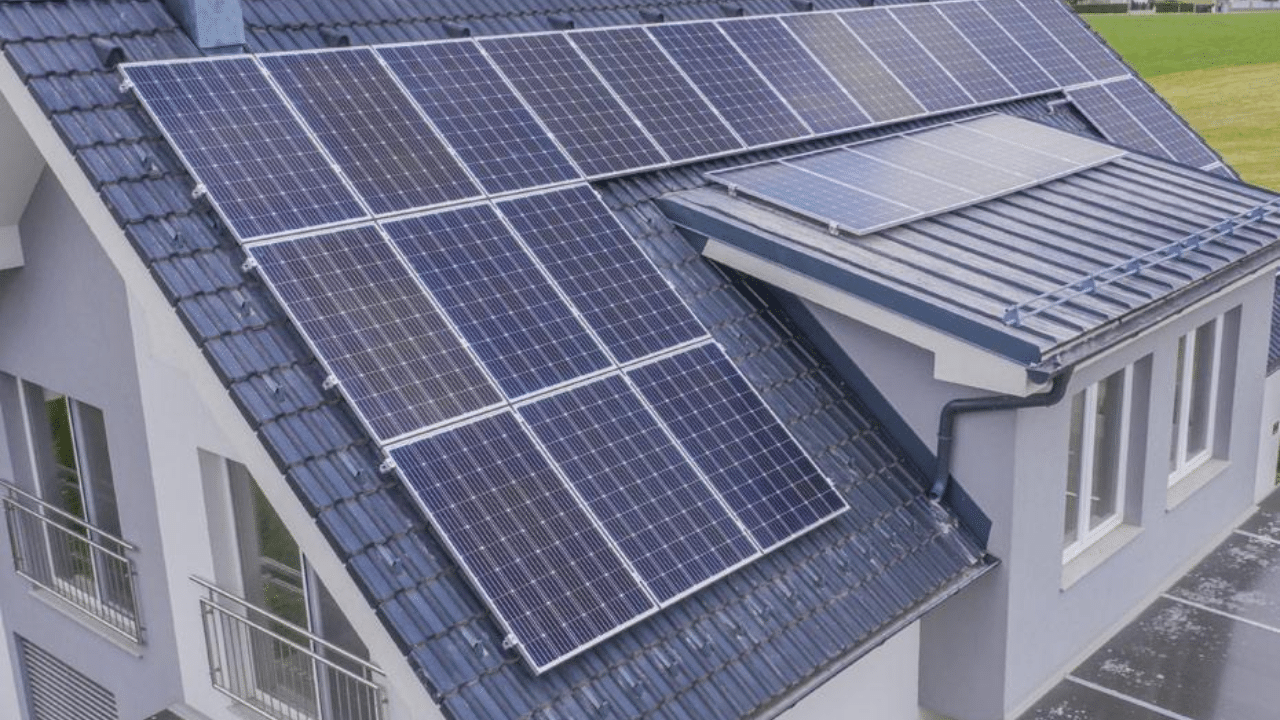
From the end of May, when designing your new home you’ll have to design it with solar panels in mind, either photovoltaic or thermal. The design will have to optimise ‘solar energy generation potential’ based on the solar irradiance of the site. The idea is to make it cost effective to eventually install solar panels later down the line.
The requirements are for a ‘suitable solar energy installation’ to be installed on the building. Most common would be standard photovoltaic panels (SPV) to generate electricity from ground or roof-mounted PV panels, but you could equally plan for solar thermal (solar panels that generate hot water), or have the roof covering double up as your solar panels with Building Integrated PhotoVoltaics (note that BIPV tends to be more expensive and less efficient at generating electricity than SPV).
From 2030, solar will become mandatory on all new residential buildings and new roofed car parks adjacent to buildings. All new homes must be designed to be Zero Emissions Buildings (ZEB) by this stage.
Road to 2030 – What is a Zero Emissions Building (ZEB)?
Very high energy performance building (excellent insulation and airtightness).
Requires zero or a very low amount of energy.
Produces zero on-site carbon emissions from fossil fuels.
Produces zero or a very low amount of operational Green House Gas (GHG) emissions.
All new buildings will be ZEB by 2030.
BER Rescale
One of the most significant changes to a homeowner will be the re-scaling or harmonisation of the BER scale. There will be a new condensed BER scale that will be the same across all European countries.
The scale will be reduced from the current 15 ratings (A1-G) to a simpler proposed A to G scale with the possibility of A0 for zero emissions buildings and additional indicators. Currently BERs are mandatory once you’ve finished building your home, or when you go to rent or sell it. As of May 29th, when you carry out a major energy upgrade you will also need to get a BER done.
Renovation Passports
Building renovation passports will be available in ROI from the end of May 2026 to help building owners make decisions on how to go about their staged renovation.
Currently, alongside your BER you get a (somewhat generic) advisory report explaining what measures would increase your BER. This will be replaced with a building renovation passport which is both a historical document and a roadmap on how to get to zero emissions buildings.
The passport will allow the new owner of a building to know the history of the initiatives and diagnoses already made on the property, saving on the cost of doing surveys and avoiding unnecessary repetition of actions.
The building renovation passport will provide a long-term, tailored renovation roadmap for a specific building, following a calculation based on available data and an on-site audit carried out by an energy expert. The building passport will identify and outline deep renovation scenarios, including steps to implement energy saving measures that could improve the building’s energy performance to a significantly higher level over a defined period.
One of the aims is to provide better information to homeowners so they can see the benefits of energy upgrades and provide a roadmap on how to get there.
The renovation passports will be part of the wider Digital Building Logbook information network, a common repository for all relevant building and energy performance data, i.e. BERs, renovation passport, smart readiness indicator (SRI), lifecycle Global Warming Potential (GWP).
It’ll be used to track building renovations and monitor progress, and give access to the building’s information to relevant stakeholders such as financial institutions and independent experts.
Global Warming Potential (GWP)
This will be an indicator which quantifies the global warming potential of a building along its full lifecycle. EU countries are required to develop an embodied carbon database and GWP methodology.
It considers the entire lifecycle of a building, such as building materials, operational building energy performance and building demolition. It may help with decision making such as whether to demolish and rebuild or retrofit a building. For example, renovating an existing building will typically have a lower carbon footprint than a new building.
It will be included in the BER from January 2030 for all new buildings in ROI.