How much of an uplift can you get from adding photovoltaic (PV) panels to your home? Ciarán Hegarty looks at how they affect your energy rating.
In this article we cover:
- Common retrofit scenarios
- New build scenario
- Graphic to show the potential uplift
- Holistic approach to energy upgrades
Photovoltaic (PV) panels are becoming increasingly popular for many obvious reasons. They provide free energy to the home by converting sunlight into electricity and limit our reliance on fossil fuels. And they can lower the energy rating of your home significantly.
But how much of an uplift in your building energy rating (BER) can you expect from solar panels? When your BER is being calculated, a wide range of factors are taken into account.
These include the size and exposure of the building, material used for construction, thermal insulation, ventilation, lighting types, efficiency of heating system, hot water use, solar gain through glazed openings and renewable or alternative energy generating technologies. The combination of these factors determines the BER.
Based on these parameters, the BER will calculate energy consumption for the dwelling in kWh per sqm per year. As long as the house is built as seen on paper you know that the better the rating, the lower the energy consumption. Therefore, if you are generating your own energy to power your appliances or lighting for example, you are decreasing the energy consumption required.
This, along with an energy efficient heating system and high thermal insulation will lead to a lower BER. Let’s take a look at the scenarios below for an idea of how much PV panels can improve your rating.
Retrofit scenario
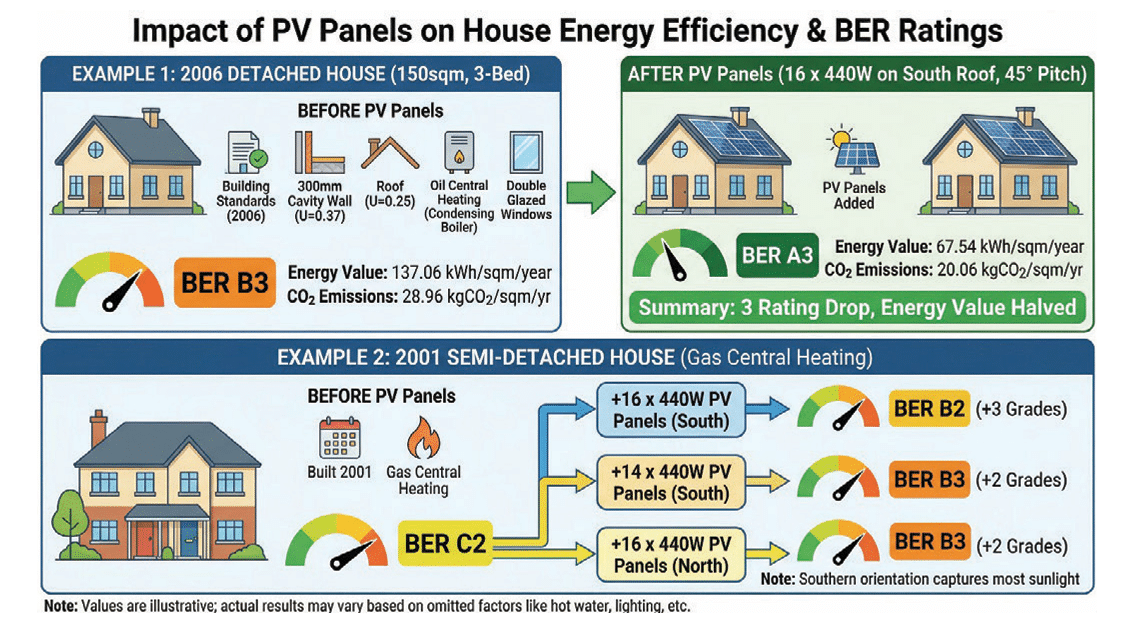
If we take a 150sqm three bedroom detached house built in 2006 and assume proper building standards at this time, we can expect a 300mm cavity wall with a U-value of 0.37W/sqmK, a floor U-value of 0.37W/sqmK and finally a roof U-value of 0.25W/sqmK.
We’ll include an oil central heating system with a condensing boiler and double glazed windows of that time. This particular setup would return an energy value of 137.06kWh/sqm/year and a BER of B3.
Of course, this is not going be the same for all houses of this size and setup; I have omitted any hot water values, lighting types, etc. If I was to add 16 x 440W PV panels to the south roof of this house and assume the roof has a pitch of 45deg, the energy value will drop 67.54kWh/sqm/year and lower the BER to an A3.
This is a significant drop in both values. The house will also drop its carbon dioxide emissions from 28.96kgCO2 per sqm per year to 20.06kgCO2 per sqm per year. As you can see from this example, this house has dropped three ratings and halved the energy value.
If we take another example, you can see that gas central heating follows a similar vein. A semi detached house built in 2001 with a gas central heating system would return a typical BER of a C2.
The addition of 16 x 440W PV panels would improve this rating by three grades and would return a rating of a B2. The addition of 14 x 440W PV panels would improve it by two grades and return a B3 rating.
Orientation is important here as the same number of panels on the north side of this sample house will only improve the BER to a B2. The southern orientation will always capture the most sunlight.
However, it is also important to point out that the indoor environment has not gotten any warmer or more comfortable. A lot of people assume that if the house has an A rating, that it must be warm and comfortable. As this example shows, that’s not always the case.
Other than installing the PV panels, the outside fabric remains untouched. The same heat is going to escape through the fabric of the building prior to PV installation. The energy balance has swung favourably in the renewable technology’s favour but the heat loss remains the same.
New build scenario
If we take a new build, constructed to building regulation standards and current best practice, we will f ind the insulation thicknesses has increased, the orientation of the building has been optimised (or at least taken more into consideration than it would have had decades before) and the glazing made more strategic in terms of increasing solar gain (providing more heat and light).
The heating system is typically a heat pump which relies on electricity to run as opposed to fossil fuels, and without PV panels, most modern day houses will still reach an A2 to A3 rating.
With the addition of PV panels, this will increase to an A1. You now have a relatively self-sustainable house whereby the space and water heating is provided by a heat pump which is powered by electricity which is generated on site through your PV Panels.
The heat you produce is kept inside the fabric of the house because the insulation is so high and the envelope so airtight that little heated air escapes.