In this article we cover:
- Research showing real energy use in Irish homes is similar across all Building Energy Ratings
- By how much the Irish government is lagging behind targets
- The cost barrier: how much people are paying for retrofits
- The comfort barrier: behavioural reasons people are not investing in retrofits
- Disruption cost: how much people would expect to be compensated for the inconvenience of a retrofit
- Why the EU Commission just issued an infringement notice against Ireland
Energy ratings don’t reflect real household consumption, according to recent research from the Economic and Social Research Institute (ESRI). And Ireland is unlikely to meet the targets set out in the Climate Action Plan for decarbonising residential heat.
As Ireland grapples with the ‘comfort barrier’ and high retrofit costs, the ESRI says “progress is lagging considerably behind” what’s required to achieve government targets.
Real energy use similar across BER bands
One key issue is the building energy rating (BER) system. The BER estimates how much energy will be used in the building per year for space heating and hot water as well as lighting and ventilation. It is calculated on the basis of how the house was built on plans; it does not include consumption data.
A BER is required on all new builds and when selling a property, among other scenarios.
Because BER scores are based on modelled energy demand rather than actual consumption, this can create a gap between predicted and real savings following a retrofit. The gap is likely to be due to insulation measures not being installed correctly and/or due to homeowners cranking up the heat.
One Irish study quoted in the ESRI report showed A-rated dwellings consume an average of 10,569kWh/yr while F and G-rated households consume an average of 10,964kWh/yr. Studies in the UK show similar results.
The ESRI says it’s hard to know why this is happening but that behavioural factors play a role: households living in homes with lower energy efficiency tend to heat their homes less. And when homes become more energy efficient, occupants may heat them more often or to higher temperatures, which means on average they tend to consume roughly the same amount.
“A certain amount of energy consumption may be affordable or deemed acceptable by householders, beyond which underheating becomes more common,” states the report.
Ireland is updating its BER methodology with changes expected in May 2026; eventually observed data could be included in energy performance calculations, where real data will be used to validate and/or calculate energy ratings.
Retrofit progress well behind targets
The report also highlights how far Ireland is from its retrofit targets under the Climate Action Plan. By the end of 2024, deep retrofits had reached just 11.5 per cent of the 2030 target and heat pump installations stood at only 3.5 per cent of the target.
The ESRI highlights retrofitting alone may not be enough to meet residential decarbonisation targets.
Instead, a broader mix of measures may be required, including switching households from oil and solid fuels to lower-carbon heating, improving grant targeting and encouraging smarter energy use in homes.
The cost barrier
The ESRI report states that data from the One Stop Shop scheme administered by the Sustainble Energy Authority of Ireland (SEAI) shows that the median cost of a deep energy retrofit (upgrade the insulation, ventilation, heating and windows) is €66,503 for a detached house. Of that the homeowner pays €42,900 and the SEAI covers the rest with the grant.
The SEAI document currently available online about On Stop Shop costs is below:
Note that retrofit costs will vary greatly depending on the property and extent of work undertaken.
The ESRI says that if the full cost to the householder is borrowed over five years at a rate of 3 per cent, which is available under the Government-backed retrofit loans scheme, this equates to a monthly loan repayment of €770.06.
The retrofit costs are offset by an energy expenditure saving of just under €900 per annum for a detached house, assuming a pre-retrofit BER of D2.
The ‘comfort barrier’
The ESRI adds to the capital costs the notional disruption cost to homeowners, including the likely need to move out while work takes place.
One study quoted in the ESRI report estimates the median monetary value of disruption, i.e. what a household would need to be compensated for the inconvenience of getting the work done, to range from €9,000 for minor disruption to €24,000 for major disruption.
There is also a general reluctance to change heating systems. Survey evidence cited in the report indicates that over 40 per cent of homeowners say they have no interest in making changes to their homes.
Indeed, researchers from the Irish Building Stock Observatory (IBSO) at TU Dublin, as reported in The Journal, identified the ‘comfort barrier’ as being one of the main reasons the uptake in heat pumps is slower than might have been expected.
The ‘comfort barrier’ happens when a homeowner feels comfortable enough (which tends to be the case for C-rated homes, i.e. about a third of homes in Ireland) that they are unlikely to invest in energy upgrades.
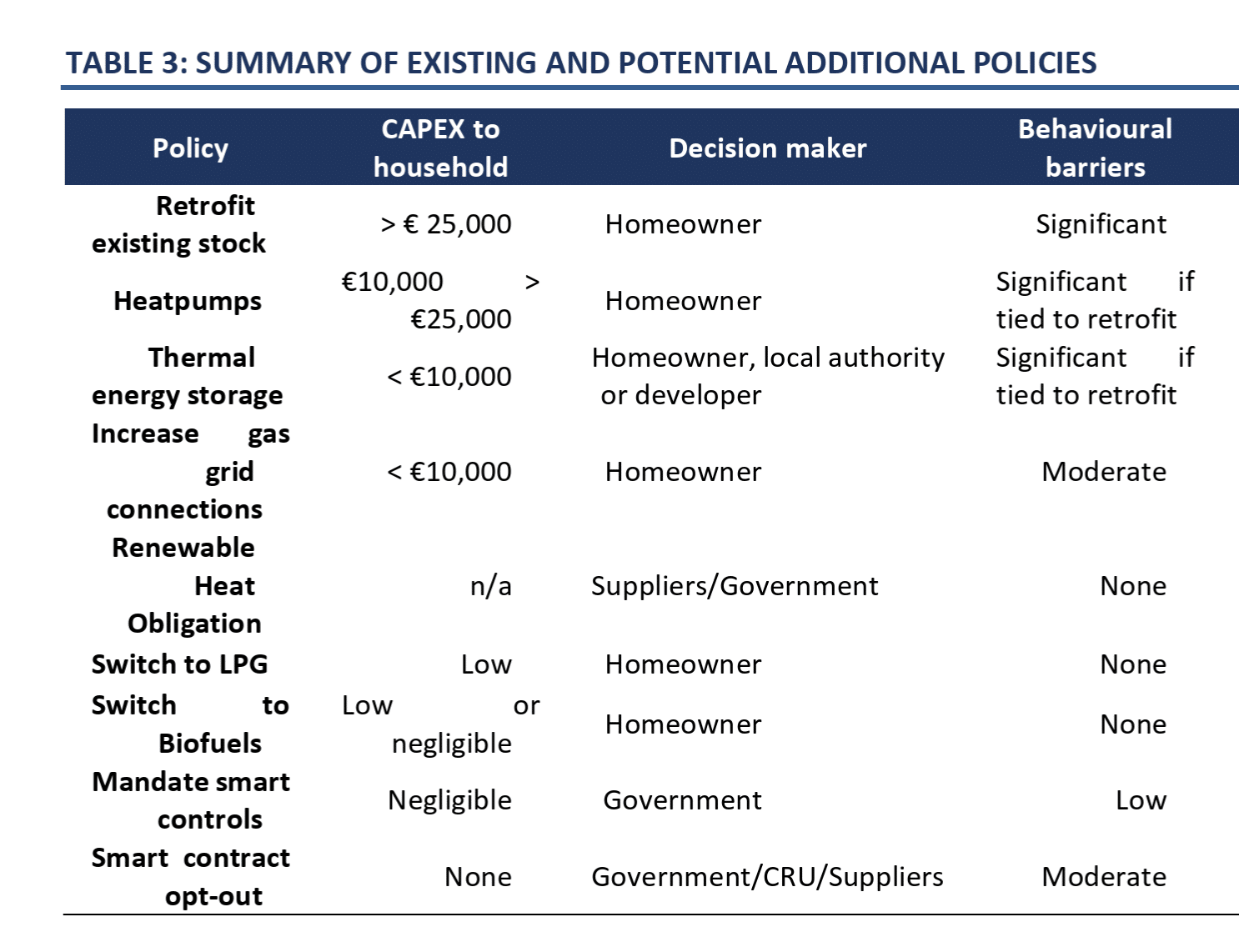
The table below from the ESRI report shows how much homeowners can expect to pay for each measure (CAPEX=capital expenditure) and how significant the behavioural barrier is.
Ireland issued EU infringement notice
The plans are a key requirement under the recast Energy Performance of Buildings Directive (EU) 2024/1275 and are intended to map out how each country will transform its building stock into a highly energy-efficient, decarbonised asset by 2050.
By setting clear renovation pathways and investment signals, the NBRPs are designed to underpin large-scale retrofit activity and help reduce household energy bills.
Ireland and the other countries involved now have two months from March 2026 to respond to the Commission’s letter of formal notice; if the response is deemed unsatisfactory, the process could escalate to a reasoned opinion.
The full ESRI report is available below: