In this article we cover:
- House hunting woes
- Decision to buy a derelict house
- Reasons to renovate the house instead of knocking it down to rebuild
- Why not apply for the vacant property or energy grants
- First steps and roadmap
- Timeline
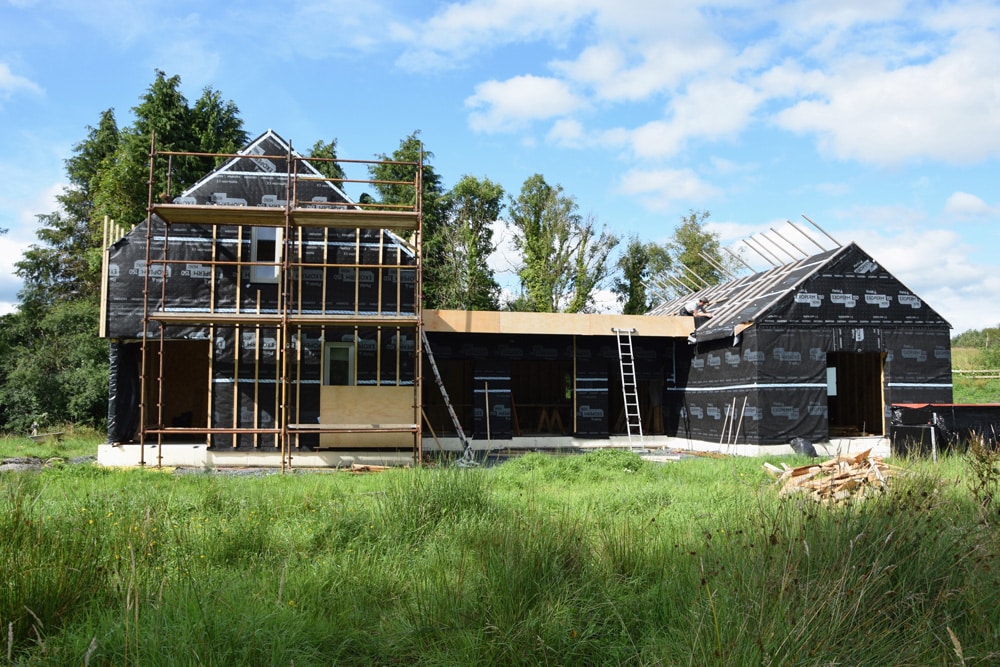
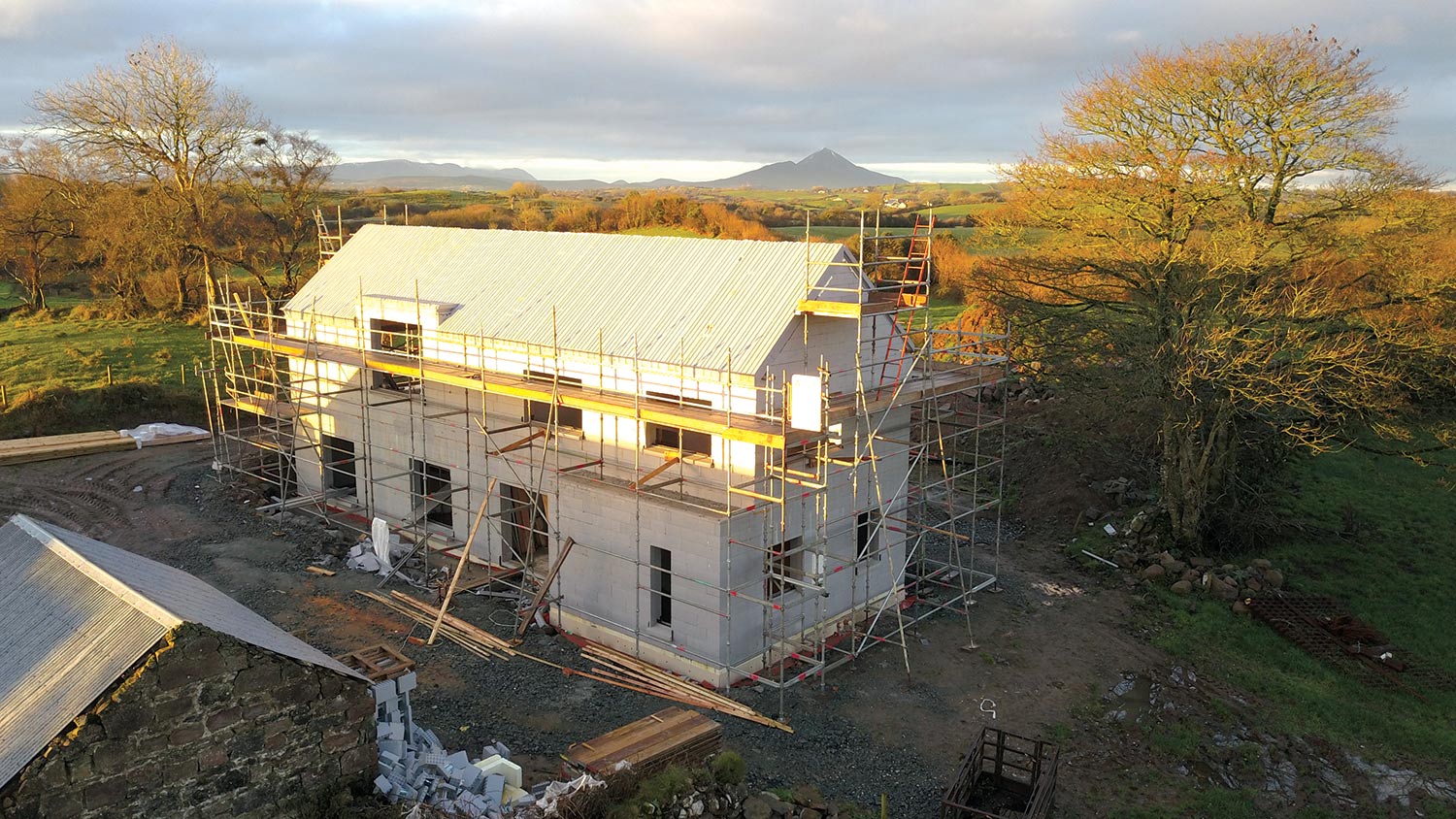
- Progress photos
Overview
House size before: 124sqm
House size after: 190sqm
Bedrooms before: 2
Heating system: Wood stoves in kitchen and living room
Ventilation: Natural
EPC before: G
Purchase cost: €80,000
Total invested so far (roof, asbestos removal, structural repairs, ceilings and joists, making it safe and weathertight): €36,000
We had been living in Co Leitrim for the crux of two decades, having moved from Manchester with our daughter to build our forever home and a new life for ourselves. Now that she was all grown up, the itch to renovate an old house took hold. We had upgraded two of our homes in Manchester and loved doing it.
We took our time with the search. Scrolling through all the online sites for properties helped give us an idea of what was out there in our budget of €100k. We knew it would buy us something that would require work. We broadened our search outside of Leitrim and I spent many months driving around bordering counties, looking at apartments, townhouses. But nothing felt right


Love at third sight
We did not set out to take on a 200-year-old cottage renovation but the minute we saw it, something just clicked. We had been casually looking for a while, not rushing the search, waiting for something to stand out. We had seen this cottage a few times but scrolled past it repeatedly. It was not love at first sight but somehow, we kept finding ourselves going back to it.
From the photos and description, it was by far the worst property in terms of the sheer amount of work that needed to be done. But we felt we needed to view it, as we just had to see it for ourselves, just to I arranged a viewing with the auctioneers and from the moment I drove down the tree-lined driveway, I was sold. It was exactly what you would picture an old Irish cottage to be, even with the dreaded asbestos roof. Full of character, set in a beautiful rural spot, and quietly holding onto its past.
Tucked away in the Leitrim countryside, the cottage had all the charm you would hope for… and all the problems you would expect. Years of neglect had taken their toll, and from the start it was obvious this was not going to be a simple renovation. This was going to be a full project. The reality hit straight away. Damp, outdated wiring, layers of neglect, and some very questionable attempts at upgrades. It did not take long to realise that everything would need to be redone. It would have been easy to focus on all of that, but instead we found ourselves thinking about what it could become. And that is the thing with projects like this, once you really see the potential, you cannot unsee it.
The work did not put us off at all. If anything, we were buzzing. I was already planning everything in my head. I remember driving to work on the phone to Steve, talking it all through. By the time I got there, we had decided to go for it. I parked up, logged on, placed the bid… and within seconds an email came through. “Congratulations – you have just bought a cottage!” Just like that, we were the proud owners of our own little piece of rural Ireland.


Reality bites
Getting the keys was exciting, but that feeling did not last long once the real work started. As we began stripping things back to the bare bones, problem after problem started to show. The scale of what we had taken on became very real, very quickly.
The plumbing needed replacing. The electrics were completely outdated. The insulation was not even worth talking about. Years of patchwork fixes meant there was nothing solid to build from. Everything had to come out.
There is a point in every renovation where the vision and the reality collide, and this was definitely ours. Standing there in what felt like a shell of a house, it would have been quite easy to question everything. And if I am honest, there have been plenty of “what have we done?” moments along the way. But this is also where the real work begins.
The first proper job was clearing the cottage, room by room, layer by layer. It was hard, physical work, but also strangely satisfying. With every wall stripped back and every bit cleared out, the house slowly started to reveal itself. Very quickly we realised there wasn’t much we could actually save. There had been so many botched jobs over the years, and a lot of the original features were already gone.
That was hard to accept at first. You always hope you will be able to keep more of the original character. On the flip side, starting fresh gave us clarity. It meant we could properly understand the building and make decisions based on what was actually there, not what we hoped might be. From early on, one thing became noticeably clear to us.
This was not going to be a restoration in the traditional sense. Of course, bringing the cottage back exactly to how it once was would have been amazing. But the reality is, we are living in 2026, not 200 years ago. Life is different now, and the way we live day to day has completely changed.
So, while we have huge respect for the history of the cottage, our focus is on creating a home that works for modern living. It is about finding that balance between keeping the character and making it comfortable, practical, and liveable. We are not trying to turn back time. We are trying to give the cottage a new life, while still respecting where it came from.
Looking back now, those initial stages were some of the hardest, but also the most important.
They forced us to be realistic and to fully commit to what we had taken on. We are still right in the middle of it, but slowly, the cottage is starting to change. Not to take it back to what it was, but to shape it into what it can be.
Decisions not to apply for grants
The Vacant Property Grant scheme is a fantastic support for many people and it’s helping bring so many vacant homes back into use across Ireland.
For us, though, it wasn’t fit for purpose as we both work full time and are restoring this cottage evenings and weekends. Plus, we can only to commit to progressing with the project as funds allow. Under the scheme, the local authority can place a charge on the property for up to 10 years, along with specific occupancy and compliance conditions.
While up to €50,000 is a significant amount of money, for us the freedom to have full control over our own investment outweighed that. You also need to complete the work within a specific timeframe. So we made the decision not to apply and to self-fund instead, which means we’ve no loans or mortgage and also haven’t applied for grants.
We’re just careful about budgeting, and we are putting in the hard graft a project like this requires. It may take a little longer but it gives us complete control over how this cottage is restored. And for us, that matters more than speed.
Renovate vs Rebuild
We’ve We’ve been asked many times why we didn’t just knock the house down and build something new. Not only did we not want to do that, the numbers didn’t add up. To demolish our house would have cost us about €30k in total, including €7k for asbestos removal (which we did have to do), €1.5k for scaffolding, €6.5k for plans and permissions and €14k for removal and disposal. Then to rebuild we would have needed at least €320k. We’ve spent €36k to get us this far and we’re expecting to spend a further €60-100k to finish, bringing the total to less than
€150k for the renovation works.


Follow Gaynor’s journey on Instagram: https://www.instagram.com/our_leitrim_life_/